Sign in to access the Staff Portal
This content requires HPCH Microsoft authentication.
What do you think you’re going to learn today? Odds are that you aren’t going to hear anything that you haven’t heard before. You might be reminded about some things that you hadn’t thought of in a while, but this is fairly basic social service material. So basic, in fact, that it’s a part of every social service discipline’s code of ethics, as well as the SFCS (and I’m guessing DCF) codes of ethics.
Most of us have some sort of bias somewhere or some sort of preconceived notions about various cultures that we’ve picked up along the way in our lives. However, we aren’t here today because we’re being intentionally, willfully, purposefully culturally incompetent, but rather, because we aren’t necessarily being as intentionally, willfully, purposefully culturally competent as our codes of ethics direct us to be.
So our goal for today is to take a trip down memory lane to the basics in hopes of bringing culture back into the forefronts of our minds. I want to make it clear that I’m not here to take a political stance or to judge what’s right or wrong. I’m simply going to provide you with information so that you can make informed choices.
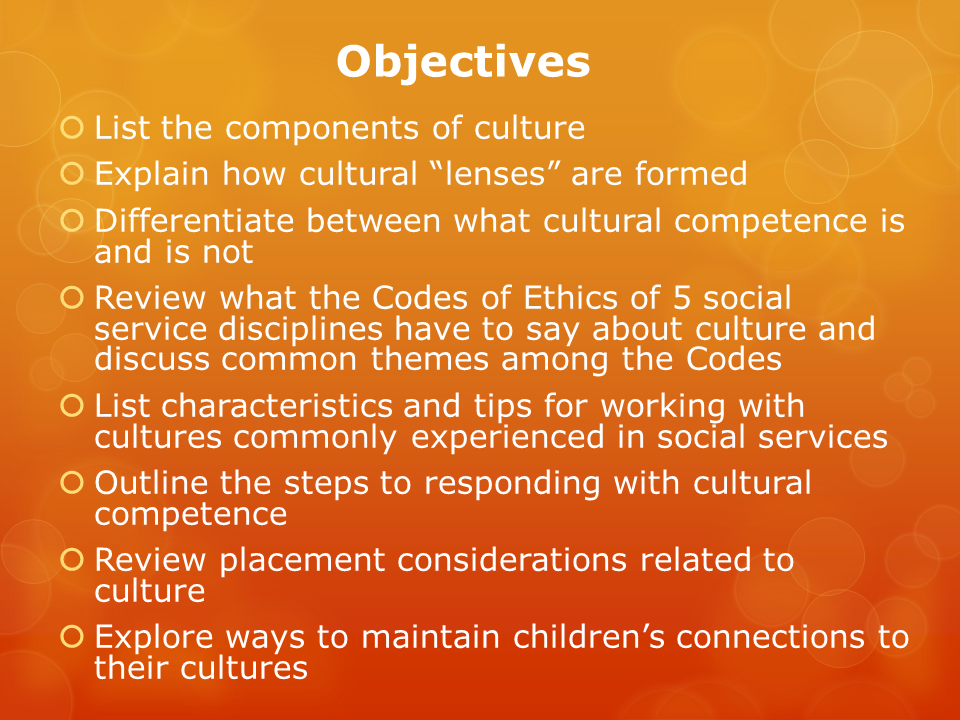
Let’s move on to talking about the components of culture. What makes up a culture? What is it that we notice about other cultures that’s different than our own cultures?
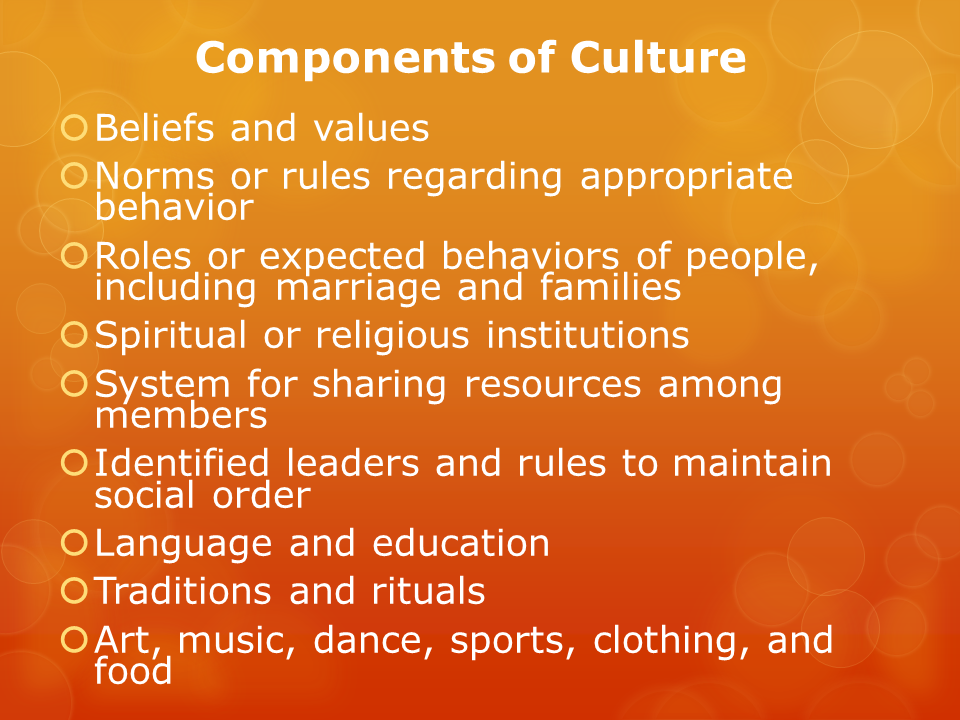
Ironically, many of these components are included in Codes of Ethics (what we believe and value, rules regarding appropriate behavior, our roles with clients, accessing resources, the language we use, our competence levels, etc.).
Would it be fair to say that each social service discipline has its own culture? Does each culture not have its own biases about their own and other cultures? Doesn’t everyone pretty much think their social service discipline is the best? But can you appreciate that other disciplines have their own strengths too? Are you ever glad some of them do what they do? Would you feel competent or even want to do psychological testing? How about substance use treatment?
So our differences are definitely strengths that we all need to appreciate about each other. We just don’t always remember to do that. The same applies to every single different type of culture out there.
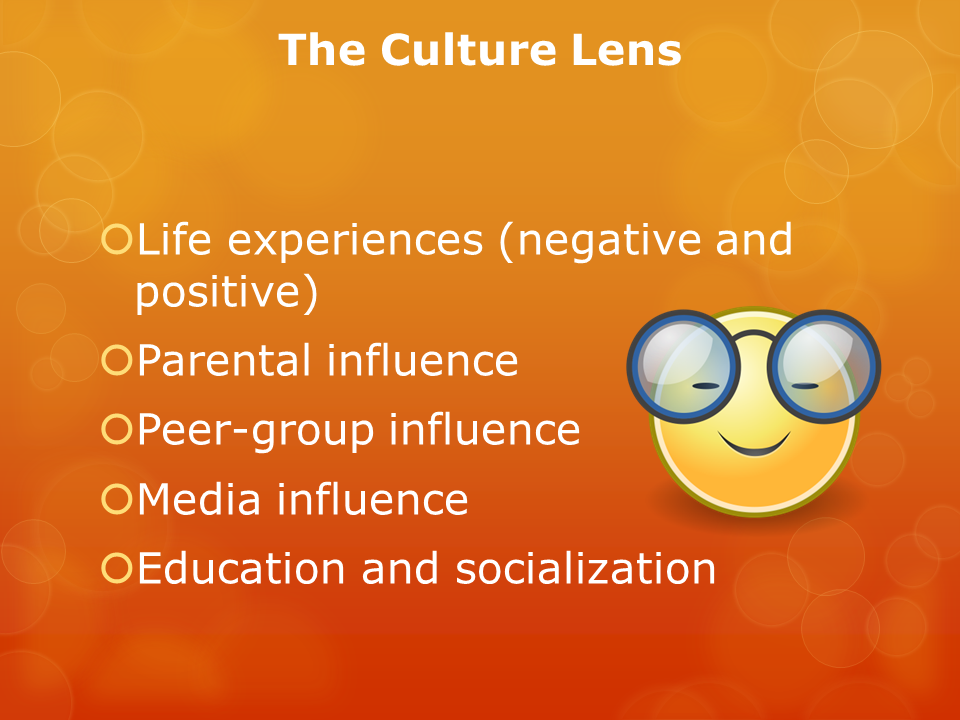
Think of culture as a lens through which we view others. How did and do we develop our lenses?
Just because we’ve been influenced, does that mean we have to accept those influences? Do you have the same views as your parents or caregivers? What about your high school friends? Your current friends? Do you agree with everything you see on the media?
One of the most significant factors that separates those of us in social services from those on the outside is an understanding of why people are the way they are and do the things they do. That doesn’t mean that we condone it, but rather, that we’re more likely to be empathetic about it. This is where education and socialization come in. We have the ability to improve ourselves and others when we educate and socialize ourselves and others about different cultures. In fact, most of us are obligated to do so by our Codes of Ethics.
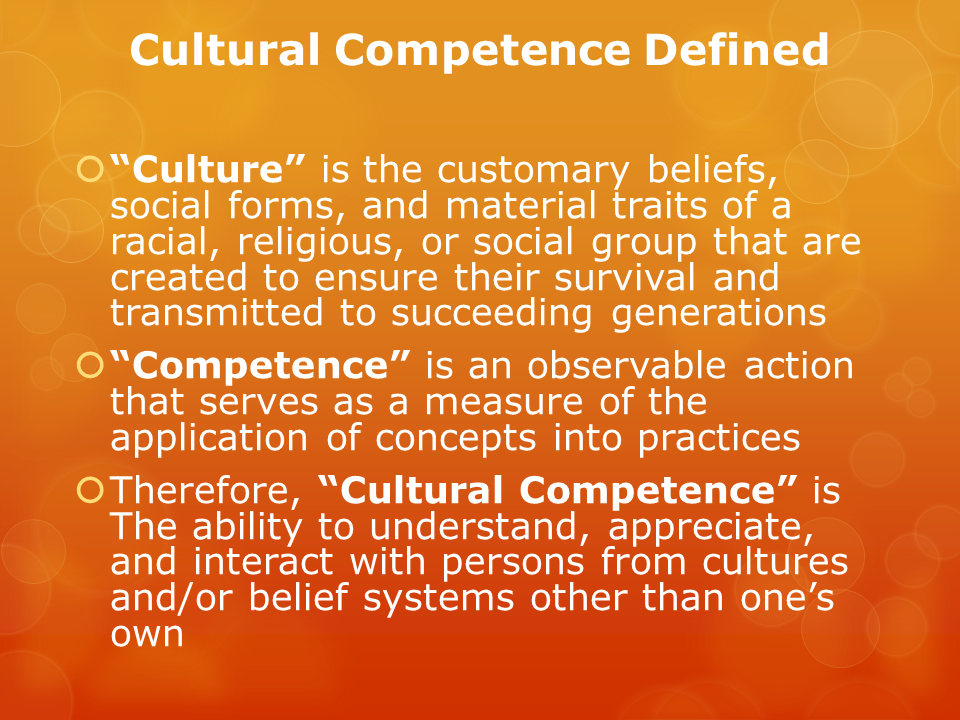
While various definitions exist, these are the ones we’re going to use for today.
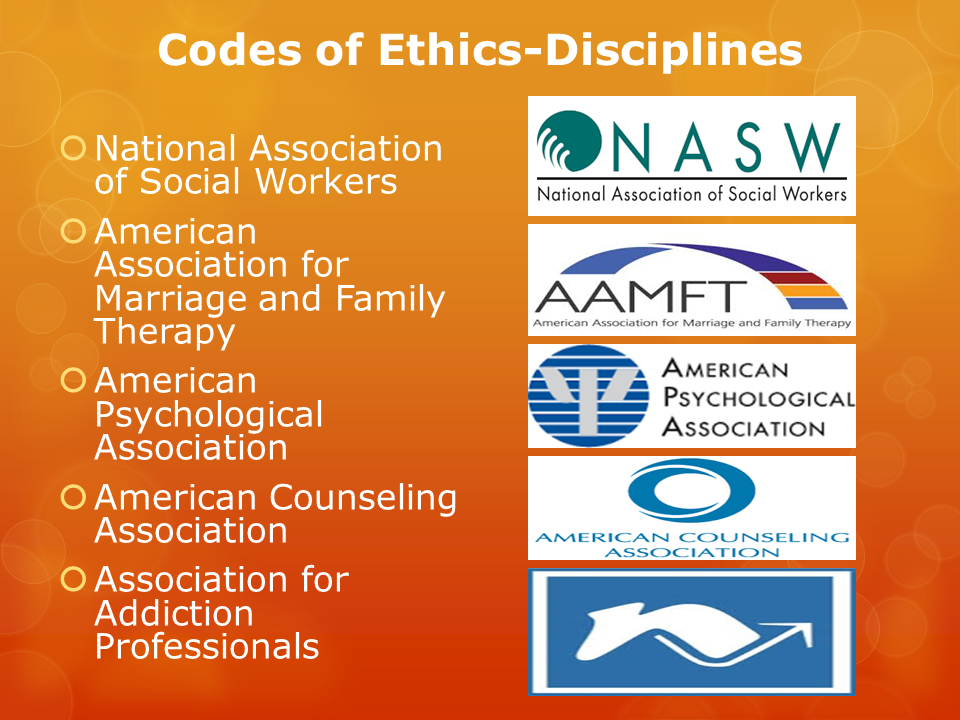
BSRB oversees 5 disciplines.
Each of these disciplines addresses the issue of culture in various ways and to various extents.
- Count off 1-5
- Go to groups
- Give each group a discipline’s code of ethics regarding cultural competence
- Choose a reader and a recorder
- Have the reader highlight the discipline’s code of ethics regarding cultural competence
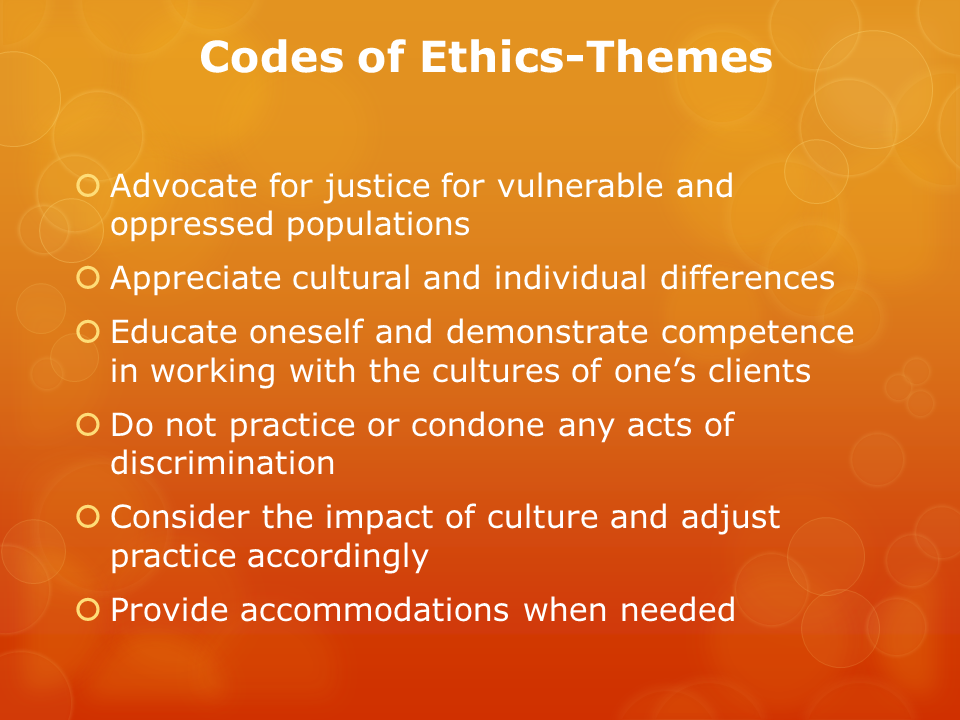
- Have the recorder record which of the common themes on this slide their group sees in their discipline’s code of ethics?
- What else do we need to know about your discipline’s code of ethics in regards to cultural competence?
- Have the recorder pick the presenter
- Return to your seats
Review “Standards for Cultural Competence in Social Work Practice” handout. Find one that you can honestly say that you do with an example. Now share it with your neighbor. Report out a few examples.
Now, while those of you who are licensed are obligated to follow codes of ethics, those of you who are not licensed are still bound by the SFCS standards of ethical conduct (or presumably something similar with DCF), which states:
“Staff should understand culture and its function in human behavior, recognizing the strengths in all cultures. Additionally, staff should be knowledgeable about their clients’ cultures, recognizing differences in race, religion, geographic areas, and family traditions.”
Sound pretty similar to the various codes of ethics? So, as long as we’re employed by SFCS (and presumably DCF), we’re ethically obligated to be culturally competent.
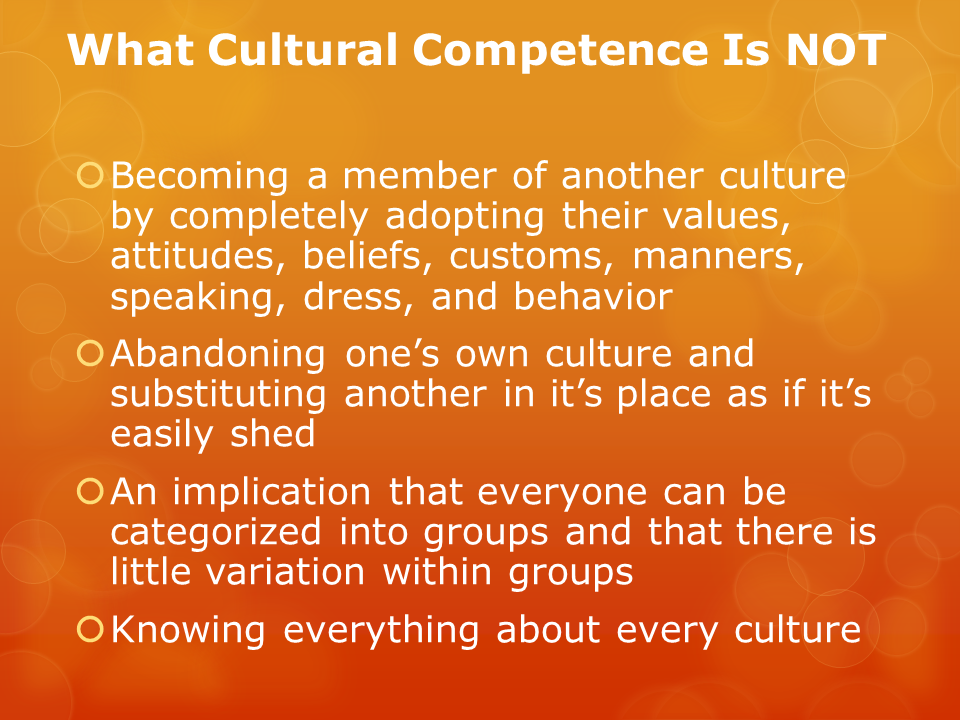
And now that we know what cultural competence is, let’s talk about what it is NOT.
Because it’s impossible to capture and memorize every single little detail about every single culture.
AND
Because there’s so much individual difference within each culture that we can’t say that all people in certain cultures are always the same. After all, while we are all human beings and some of us share common characteristics, each of us is unique with our own personalities, experiences, beliefs, and relationships.
So, what do we do?
We get to know each of our clients’ cultures just as we should be doing for every other aspect of their lives.
What is the racial, gender, age, and SES composition of this office?
It’s not a matter of IF it impacts our work. HOW does that impact our work?
Does any one factor have more influence than the others?
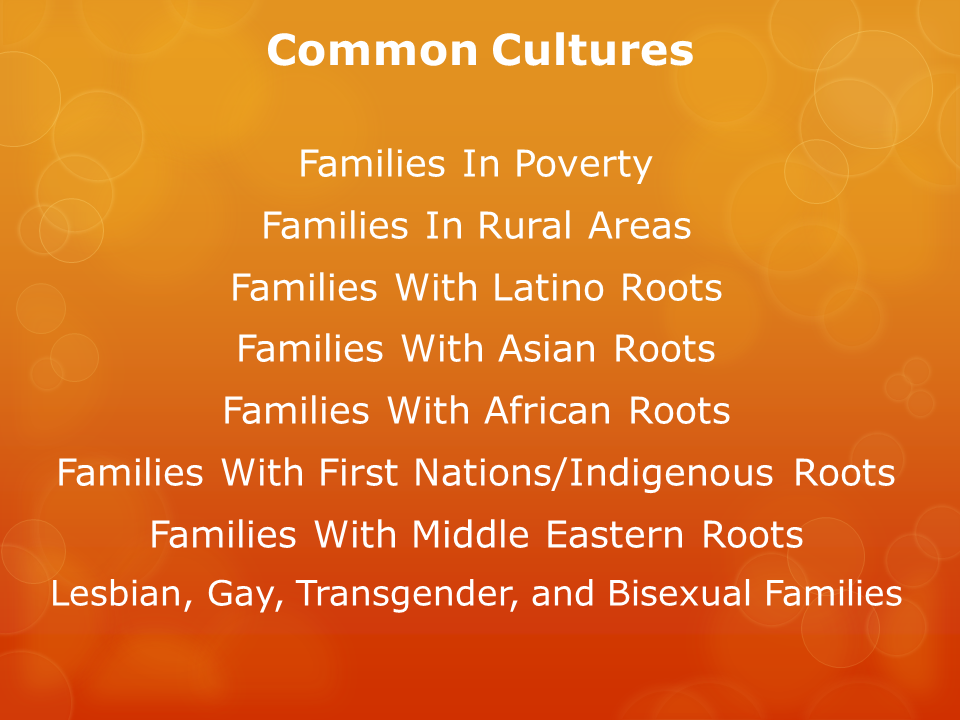
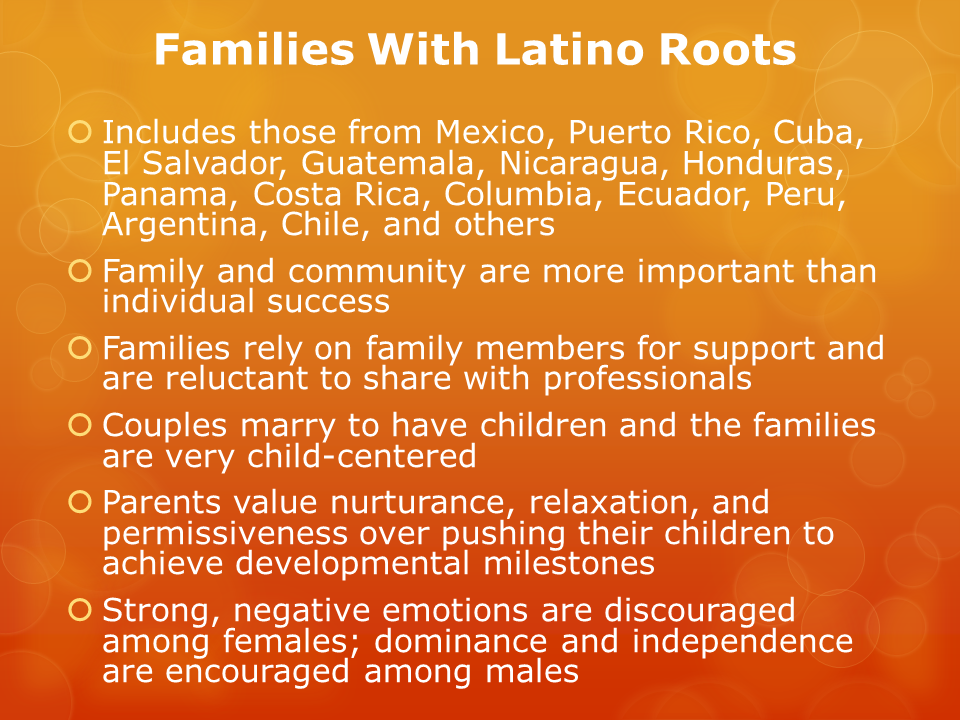
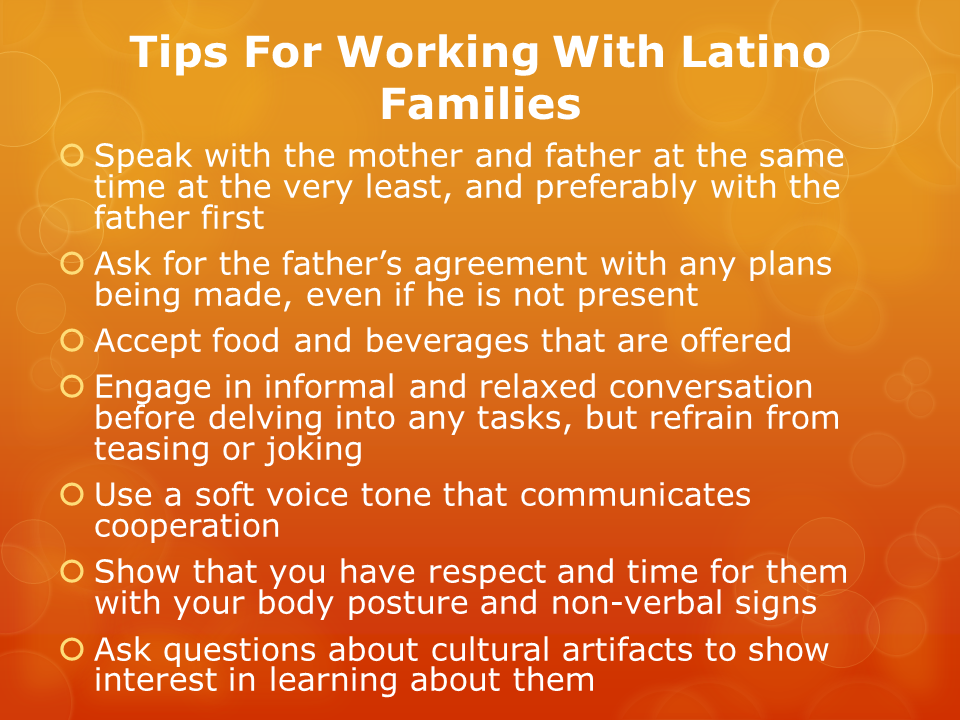
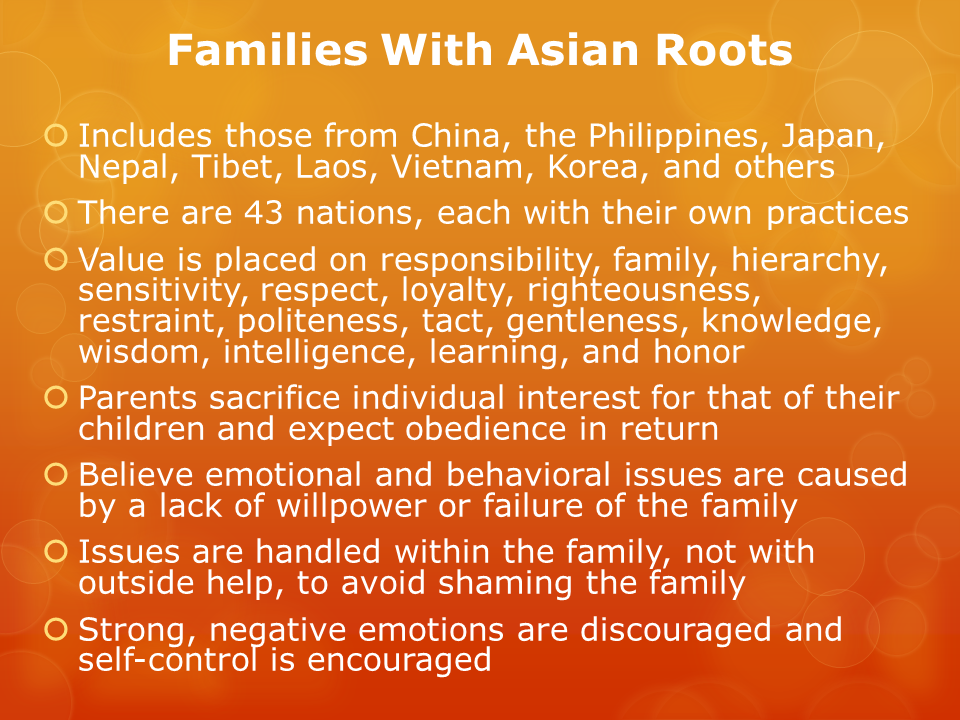
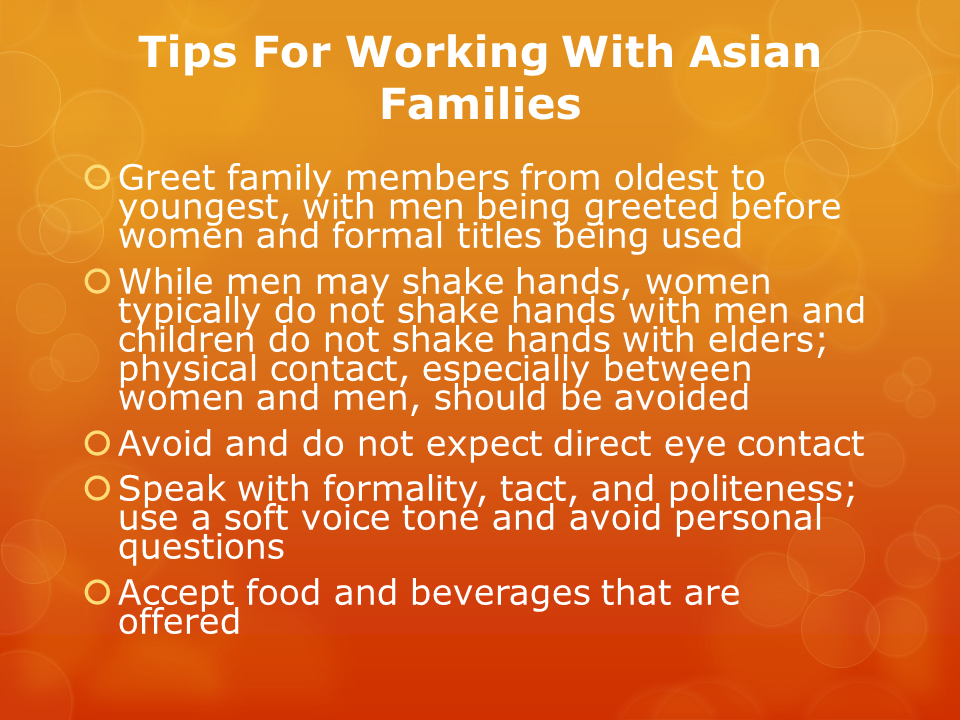
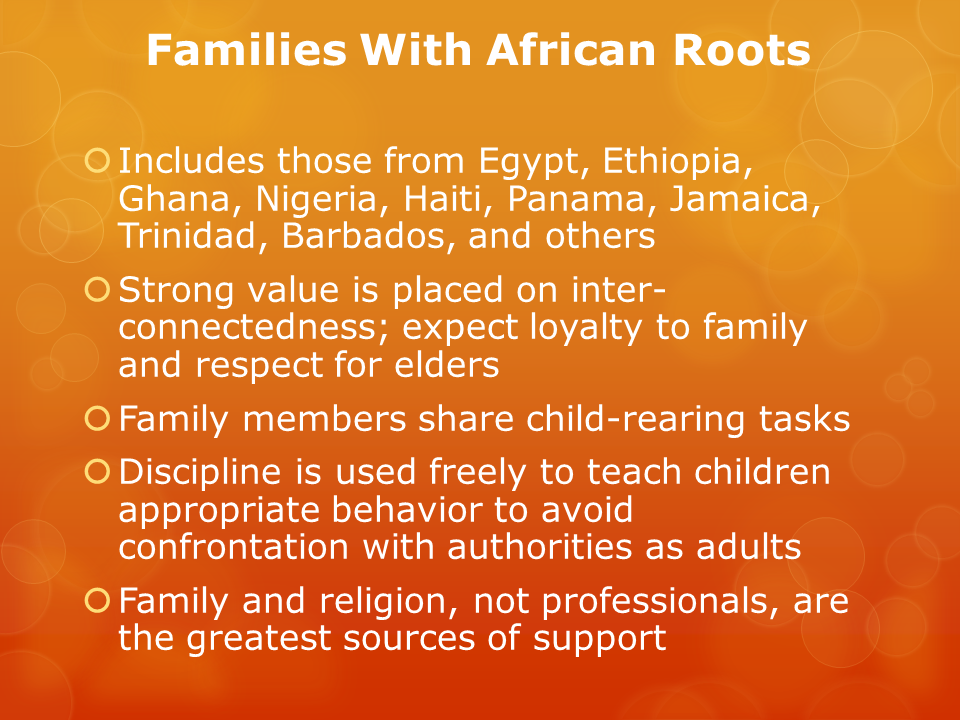
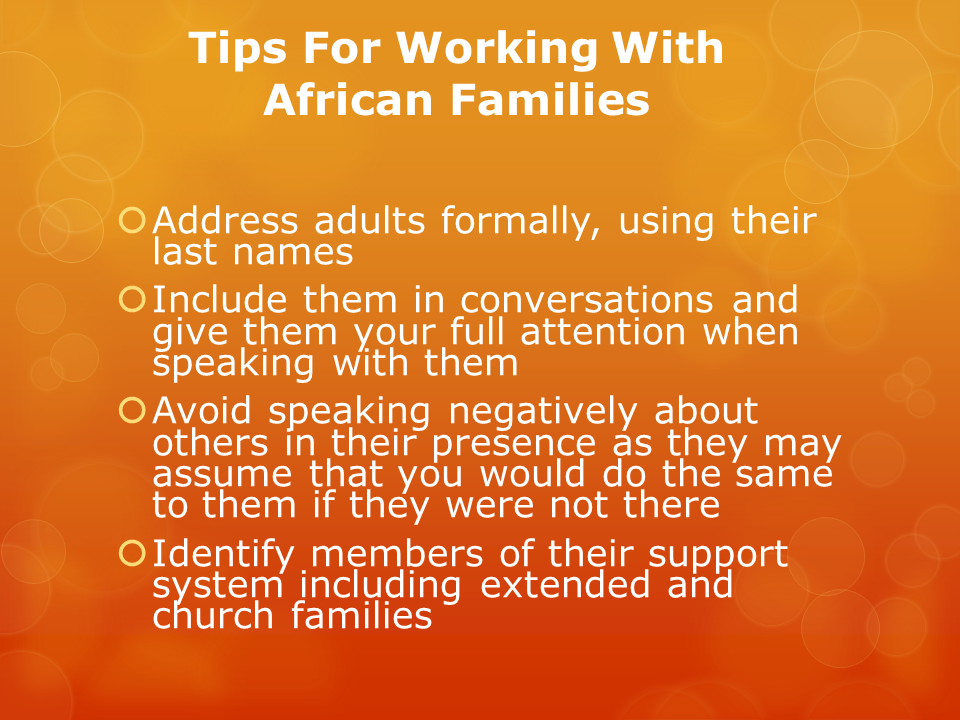
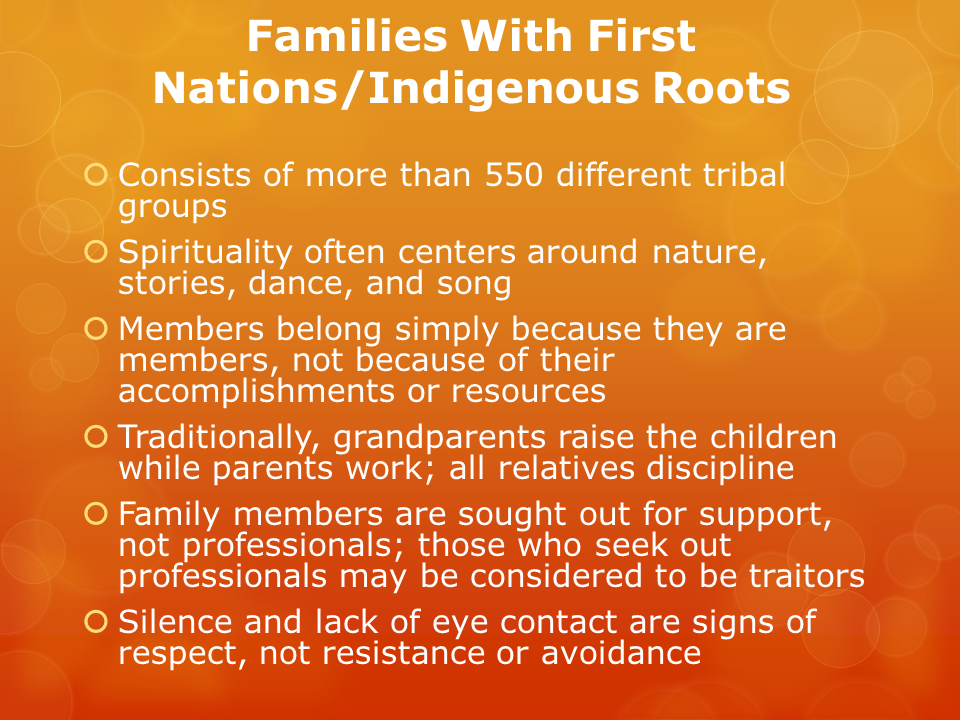
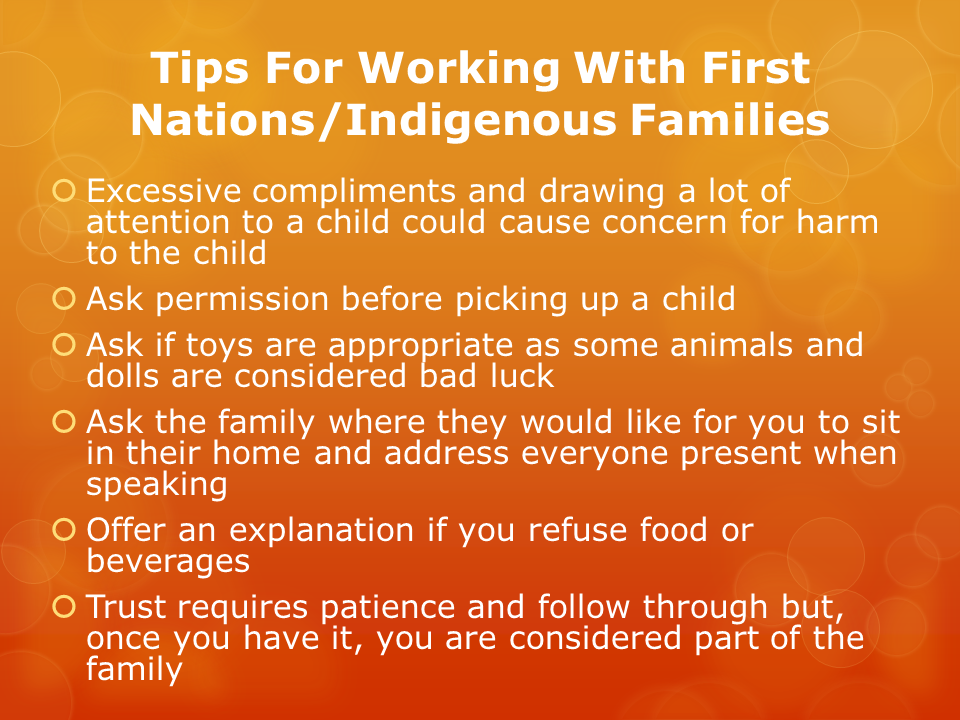
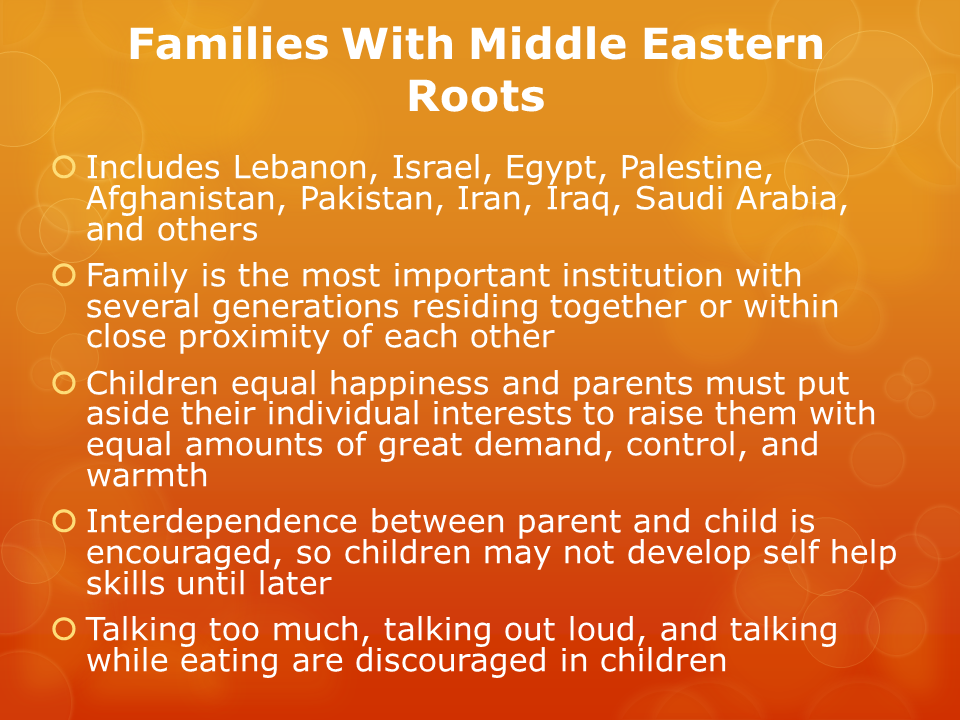
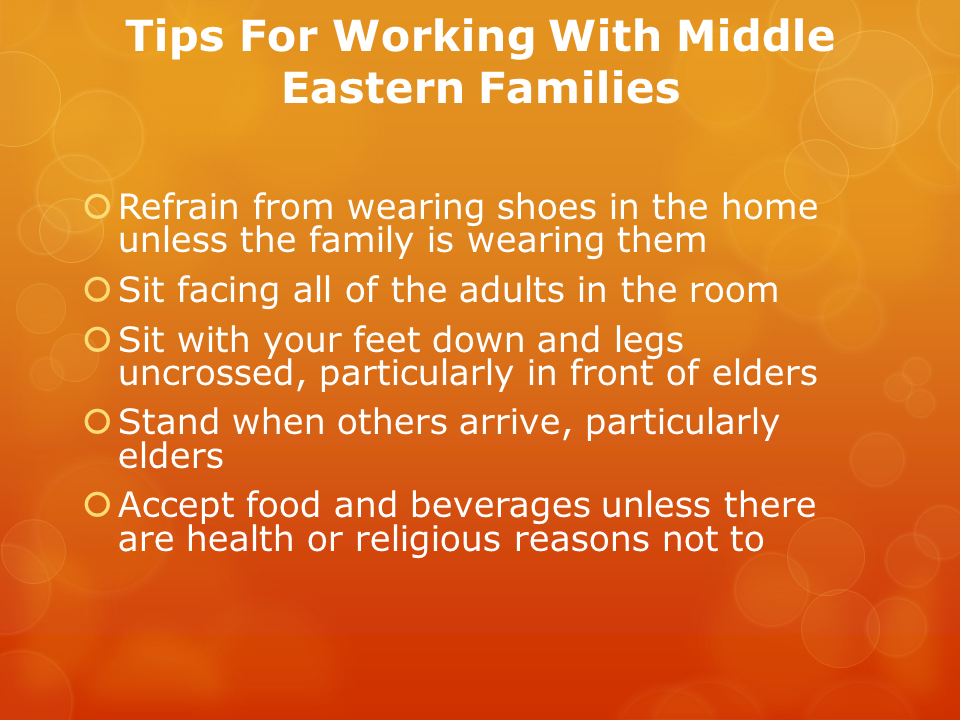
We’re going to go through some generalizations about a few of the cultures that you’ll likely interact with in your work. Generalizations are used to understand some of the common characteristics shared by members of a group, although research shows that there are more differences within groups than between groups.
Generalizations differ from stereotypes, which are assumptions about members of a group based on their inclusion in the group. We won’t spend a great deal of time on this, but rather, we’ll review themes and implications for ethical practice afterwards.
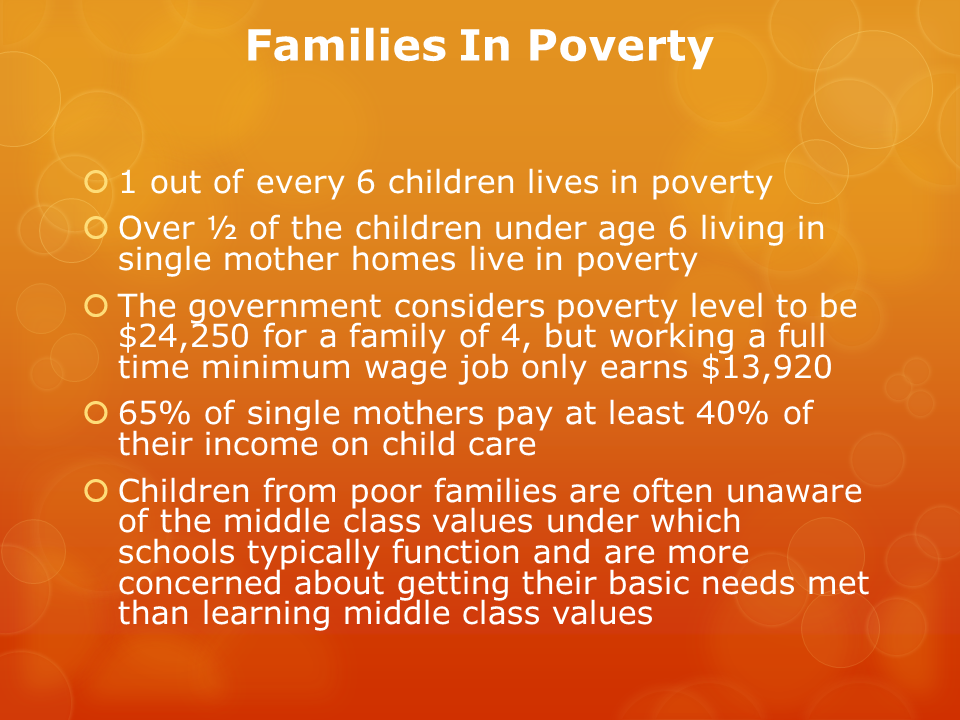
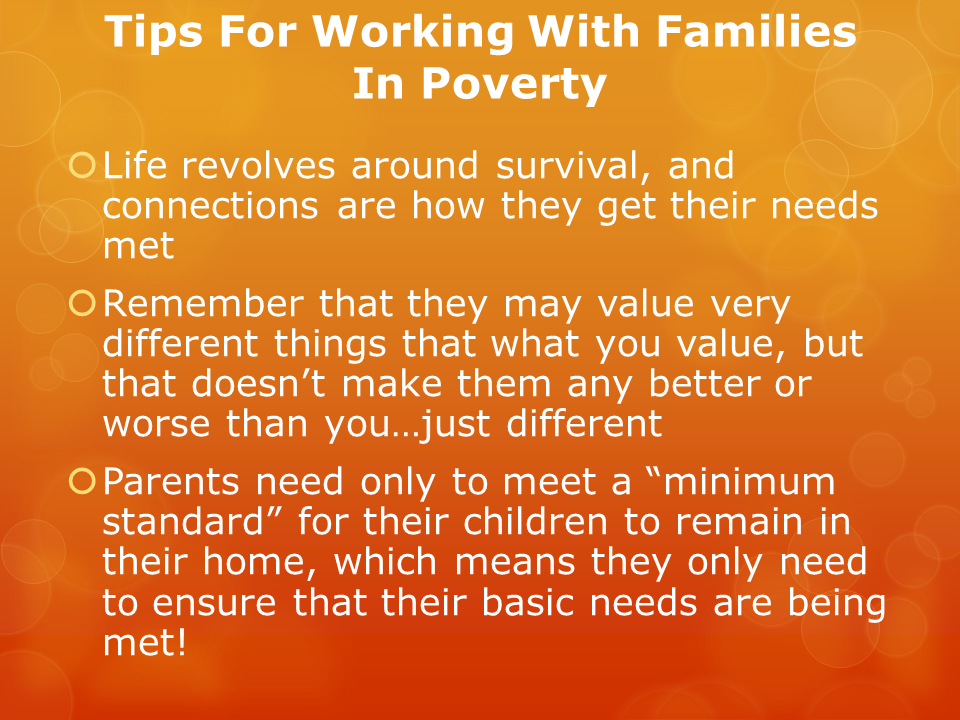
Let’s talk about minimum standards. We may not prefer to live a certain way, but are a child’s health and safety at risk? Minimal parenting standards means that a parent or other person responsible for the child’s welfare sees that the child is adequately fed, clothed appropriately for the weather conditions, provided with adequate shelter, protected from physical, mental and emotional harm, and provided with necessary medical care and education required by law. Even if that’s all they get and it’s barely that, it still meets minimum standards. When I first graduated from college and was doing investigations, I was very protective of children and thought they were better off being removed if they were in any type of adverse situation. What I came to realize over time was that no families are perfect and that most children are better off when they’re with their families. You may not believe that now, but give it time.
Show “Same Sex Couples” video before moving to next slide.
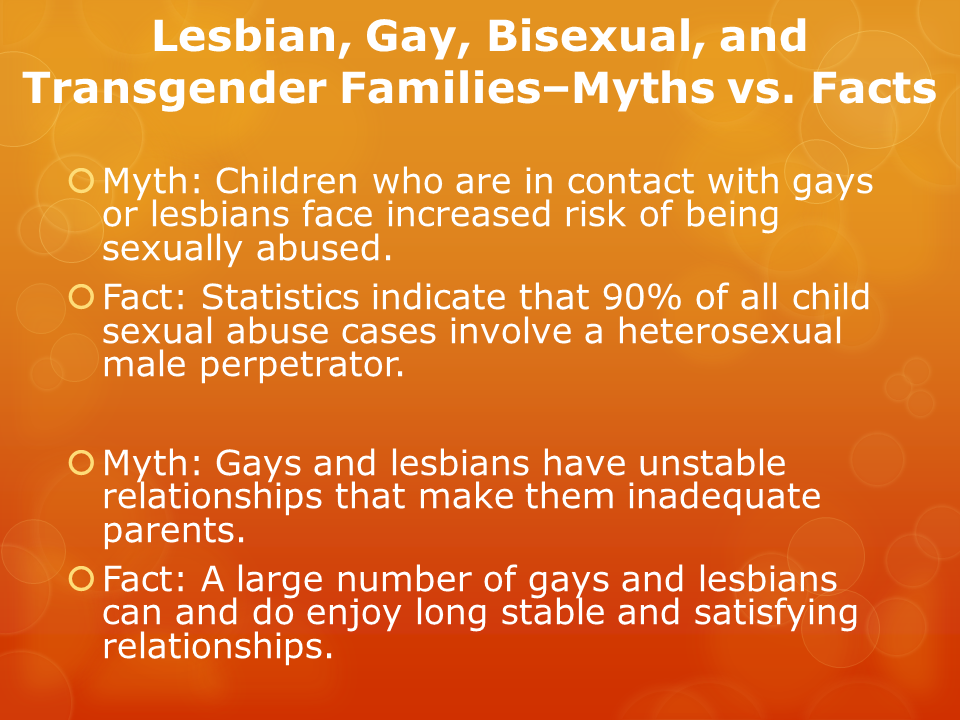
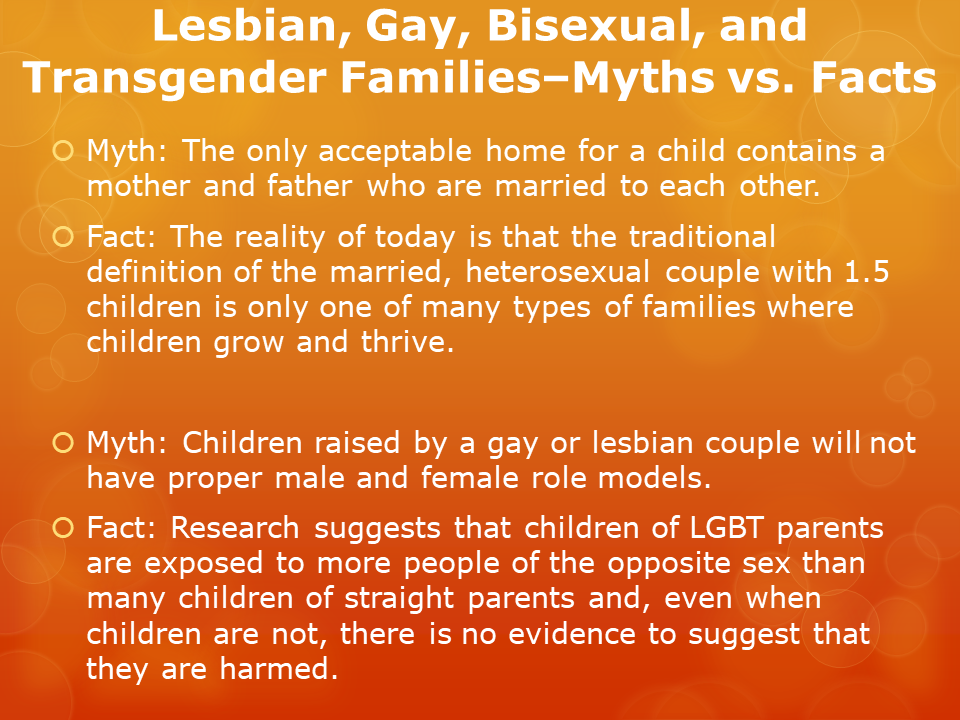
I will always maintain that, regardless of the composition of the family, the best foster and adoptive parents for children with special needs are those who have been through some sort of adversity and learned that life is tough but you stick together, get through it, and move on. For some, that “adversity” could be some form of discrimination that they have experienced and overcome.
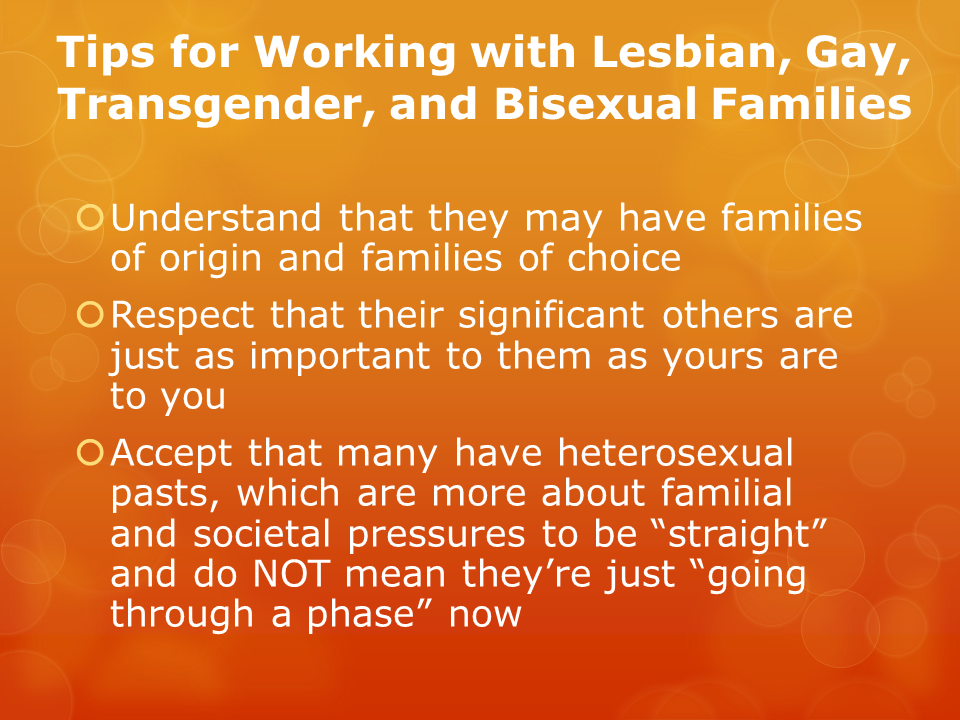
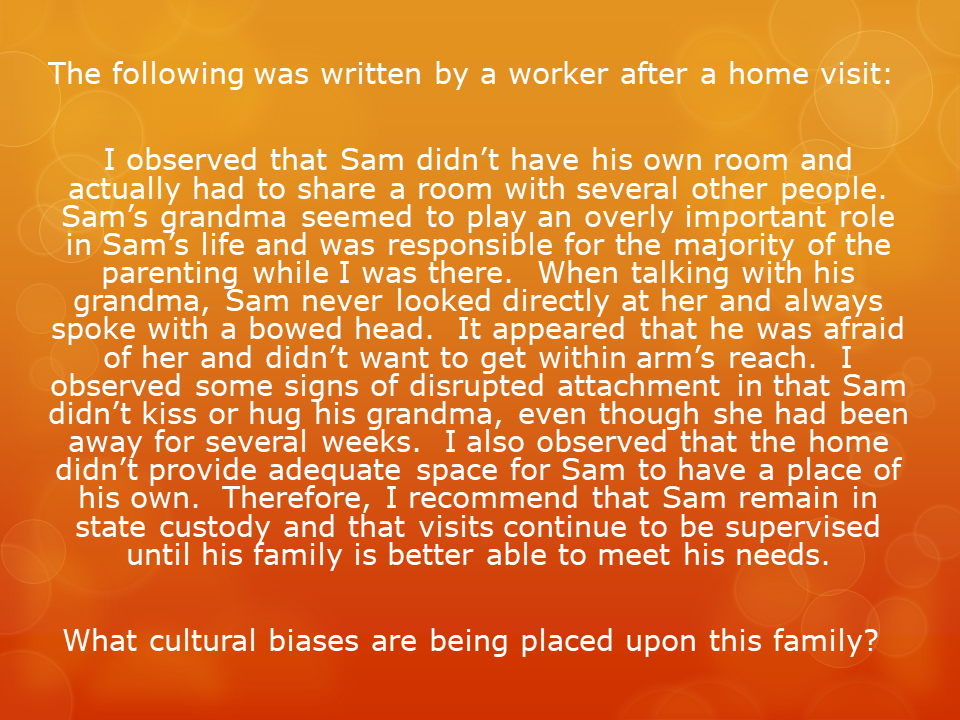
Middle class values individual achievement. The majority of every other cultures outside of middle class values:
- Family over individual
- Extended related and non-related kin
- Family over system
- Respect for elders
- Communal child rearing
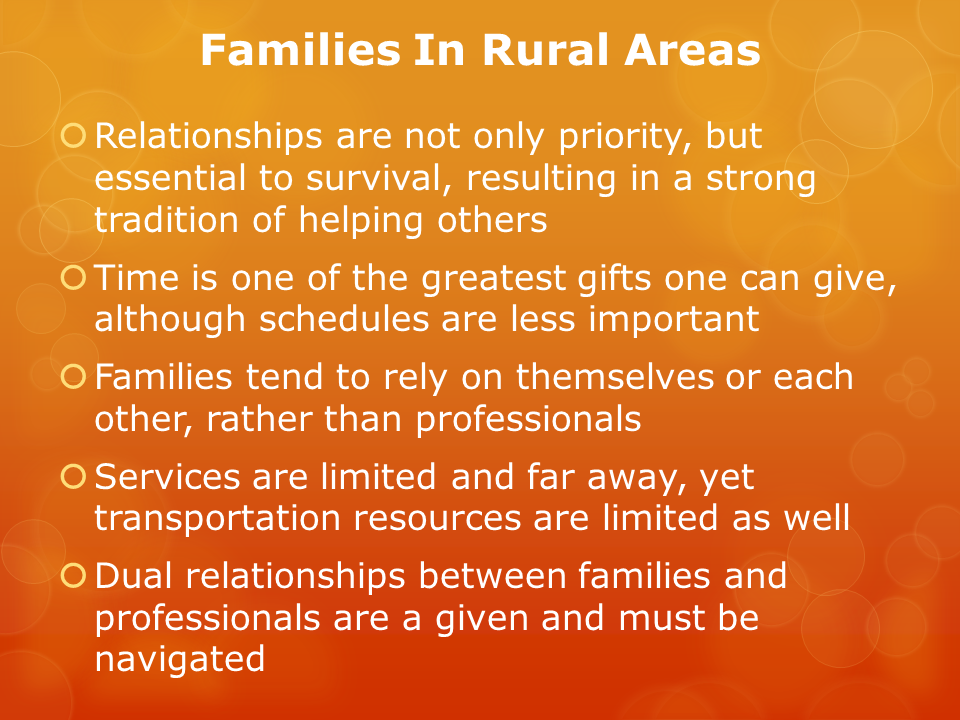
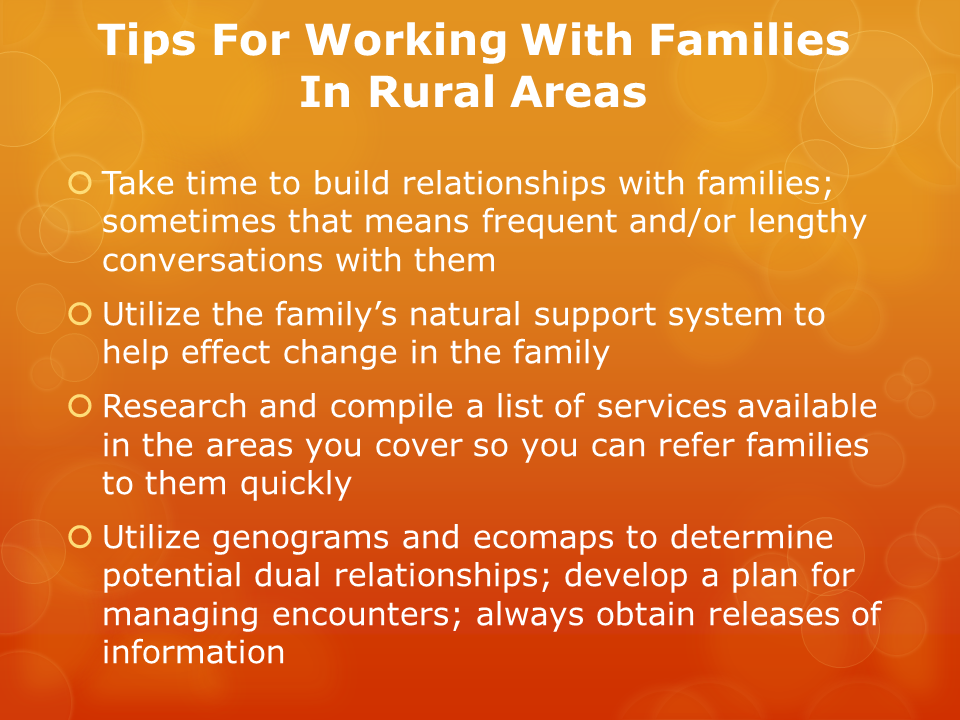
The end result? Most cultures rely heavily on connections and we need to be tapping into them, which is contrary to typical middle class culture. Our job as social service professionals is to go in, help families establish and reconnect with their natural support systems, and then get out.
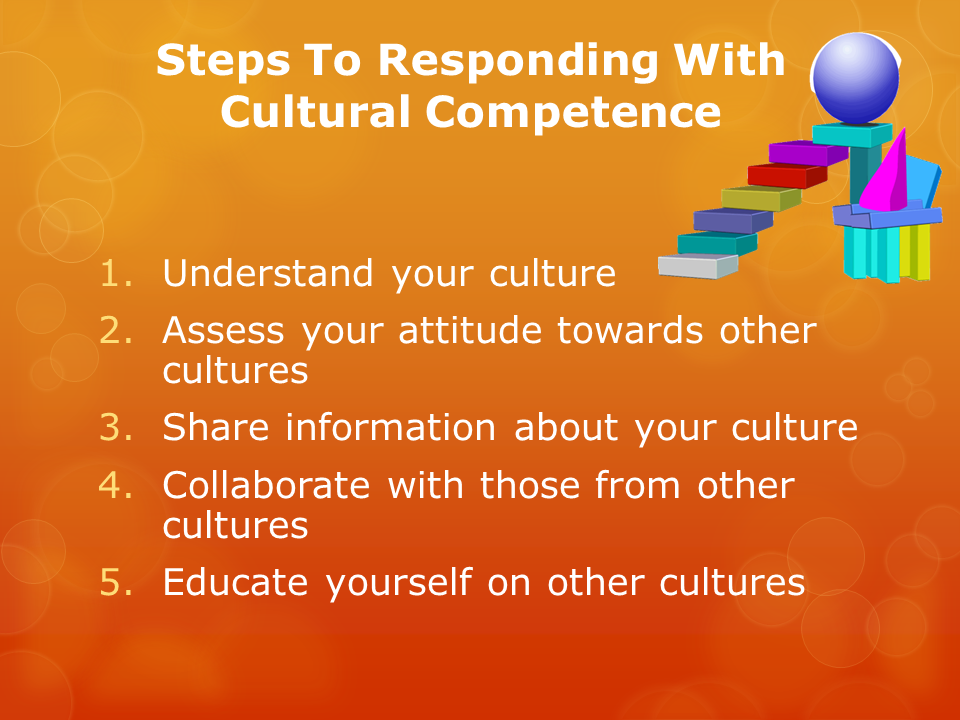
It’s been said that culture is to humans as water is to fish. We’re so immersed in it that we don’t even think about it. When’s the last time you really thought about your culture?
It wasn’t until I started researching the culture of poverty that I really understood why I’ve been so frustrated with those living in poverty in the past. It was because I didn’t understand their values, which are much different, but not worse, than mine. Mine make sense to me and theirs make sense to them. It’s just different and I can appreciate that.
So, let’s take a few minutes to understand our own cultures by completing the “My Culture” handout. When completed, please share it with the person sitting next to you. Were there more similarities or differences? Even when we think we share the same culture as someone else, our families often have their own unique cultures.
As for assessing your attitude towards other cultures, just be honest with yourselves. Like I said at the beginning, everyone has biases. Just recognize what they are, how they impact your work, develop a plan to minimize them, start educating yourself, and learn to appreciate differences.
And remember, most of our codes of ethics, even the SFCS and probably the DCF ones, instruct us to do these things as well (self-assessment, increase competence).
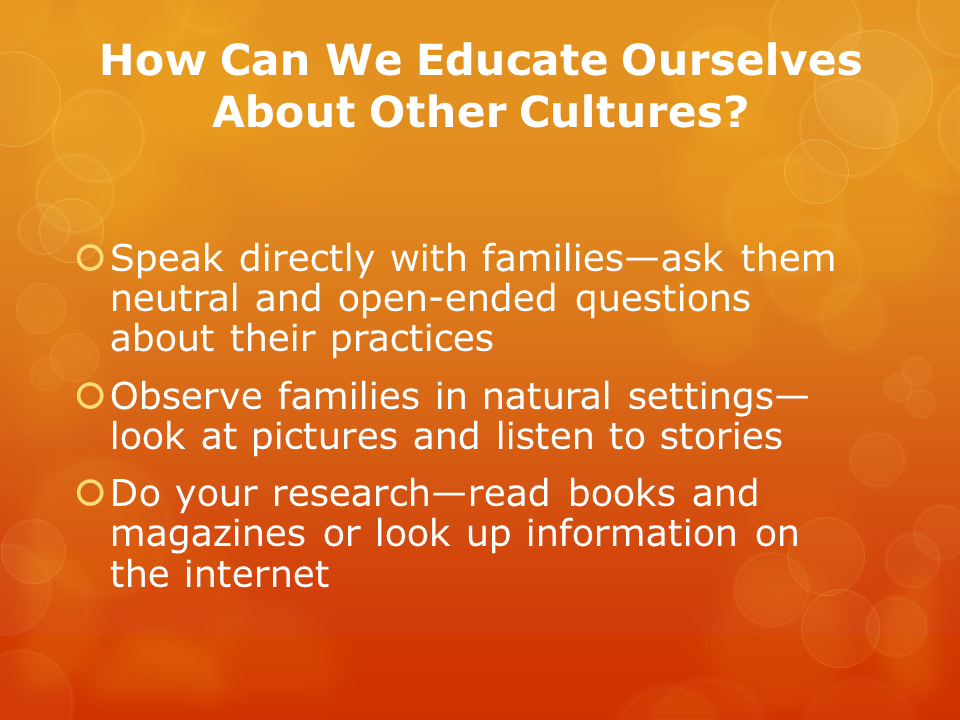
What are some examples of how you’ve asked families about their cultures? What have you observed? Has anyone ever done any research?
What do we do to ensure children are placed with the best cultural match?
- Family 2. Culture 3. Proximity
How do we assess a placement’s cultural match with a child? Do we ask them any questions?
Why is it important to keep children with different cultures connected to their cultures?
- What experiences have you had with other cultures?
- What cultural events have you attended?
- What are your extended family’s and friend’s opinions about children from other cultures?
- What plans do you have to keep children connected to their cultures?
- What resources in your community could assist with linking children to their cultures?
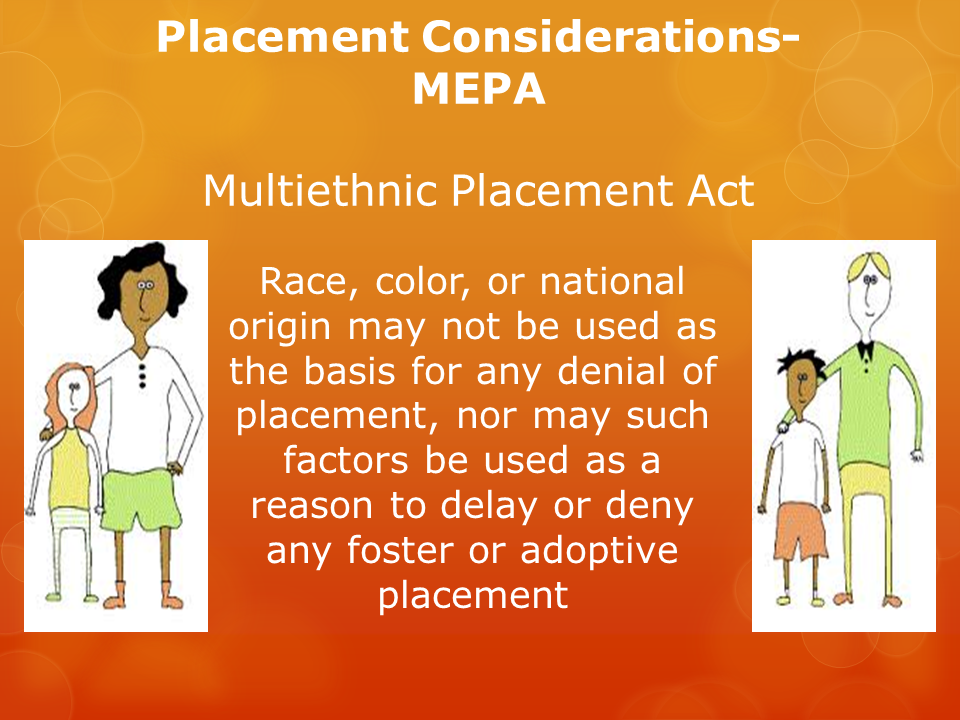
There are also some legal considerations that need to be made, starting with MEPA.
MEPA was enacted so that a child wouldn’t go without placement/permanency just because they were of a different race/ethnicity than a placement/permanency option. Nobody would be able to say “We can’t place that child with that family because they aren’t the same race/ethnicity.” So it basically eliminated that barrier.
Unfortunately, one of the few times MEPA actually comes up is when a placement/permanency option is of a different race/ethnicity than a child and they try to use MEPA as the reason why they have a right to be the placement/permanency option for the child. MEPA does not guarantee placement/permanency, but rather, eliminates barriers so that placement/permanency can happen more easily.
Has anyone had a case where MEPA has been brought up?
Has anyone had a case where ICWA was involved?
Show “Knowing Who You Are” video (0:00-3:09, 8:30-10:43, 14:28-17:24)
Themes:
- Several of the youth said they changed who they were based upon who they were around just to fit in
- What about the girl’s comment that she identified herself as a foster child first and above all else?
- Knowing their culture allows them a connection even when they don’t have contact with their family
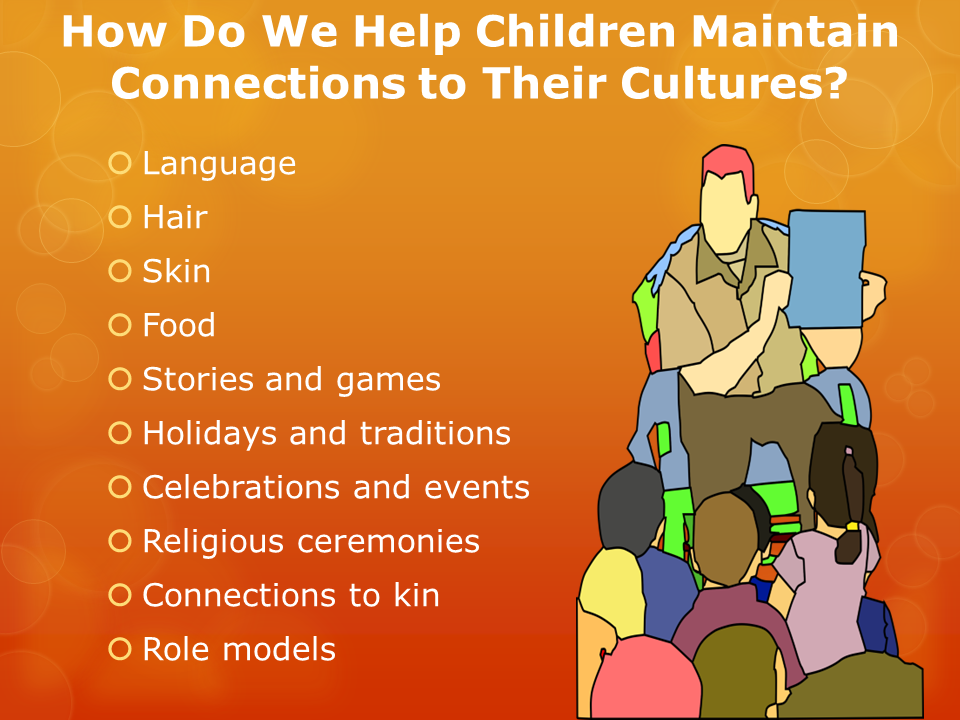
What do we do to ensure that children remain connected to their culture once they’re placed?
Being able to communicate with those with whom you live seems like a given but, for children who speak a language other than English, it’s just another way that they feel alone, different, and frustrated. We don’t often have the luxury of placing children with someone who speaks their primary language, but does their placement know anyone who does? Or, is there anyone in the agency who does? It does take some work, but can you imagine how grateful you would feel if you were all alone in a foreign country and someone finally came along who spoke English?
Think about how you feel when you’re having a “bad hair day.” Does it affect your self-esteem or at least how you feel about yourself that day? Now, what if you felt that way for the majority of the time you were in custody, while also being self-conscious about being a foster child and surrounded by people who are different than you?
Do we not feel somewhat the same about our skin? At the very least, we’re uncomfortable.
And, who doesn’t like comfort food, especially when we’re having a bad day? Children from different cultures feel the same way and they, if anybody, need every type of comfort they can get.
Most children love stories and games of some sort. Even though it seems like a small thing to do, bringing some sort of familiarity and pride in their culture into their lives can have a huge impact on them.
The same goes for holidays and traditions. Most of us have at least a few. Do you still repeat them? If a placement took the time to make you feel special by following one of yours, wouldn’t that mean a lot to you? Or, if they went out of their way to take you to a celebration or event to maintain your connection to your culture, wouldn’t that send you a message to you that you matter?
Many of our placements are involved in some sort of religious ceremonies. While they need to maintain their preferences too, do they make the effort to find out what the children’s preferences are and connect them to them as well?
Speaking of others we could enlist, how do we help children maintain connections to kin? What other cultural role models can we develop on their behalf and who else can we enlist in our search? While placements are often coming from a good and protective place, automatically cutting off contact with former connections just because they’re from their previous lives isn’t in the best interest of children.
Remember that the little things can mean the world to a child and that we are obligated by our codes of ethics to make accommodations for those of varying cultures.
Now we’re going to watch a few videos about transracial adoptions. Listen carefully to what the parents say and do that demonstrates that they “get it.”